
UAE VAT and Corporate Tax: A Plain-English Guide for Business Owners (2026)
If you run a company in the UAE, you now deal with two taxes: VAT and corporate tax. Neither is complicated on its own. The trouble usually starts when the deadlines pile up, the paperwork goes missing, or someone assumes “we’re too small for that.” This guide walks you through what each tax means, who has to register, when you file, and how to stay clear of fines.
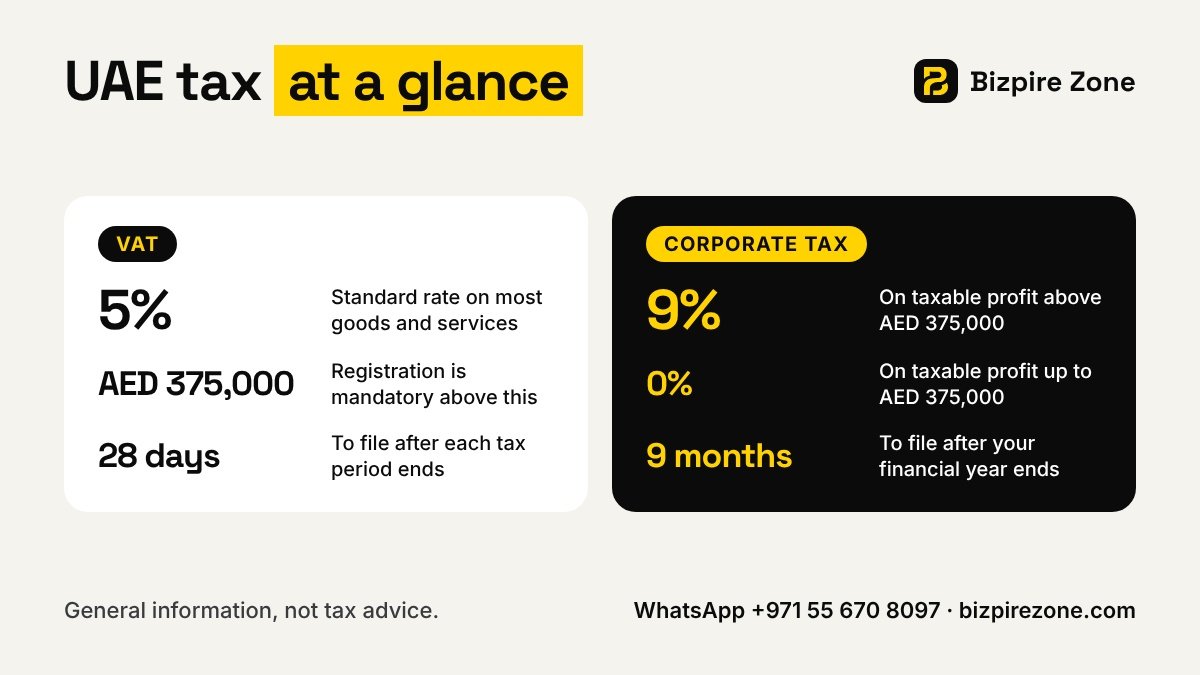
The short version: VAT is 5% and you must register once your taxable supplies pass AED 375,000 a year. Corporate tax is 9% on profit above AED 375,000, and almost every business has to register and file a return, even if it owes nothing.
What is VAT in the UAE?
Value Added Tax (VAT) has applied in the UAE since January 2018. It’s a 5% tax added to most goods and services. As a VAT-registered business, you charge VAT on your sales, claim back the VAT you paid on business purchases, and pay the difference to the Federal Tax Authority (FTA).
Some supplies are zero-rated (for example, many exports and international transport) and a few are exempt (such as certain residential rents and local passenger transport). Getting these categories right matters, because it changes what you charge and what you can reclaim.
Do you need to register for VAT?
- Mandatory: if your taxable supplies and imports go over AED 375,000 in the past 12 months, or you expect them to in the next 30 days.
- Voluntary: if your taxable supplies or expenses go over AED 187,500. Many start-ups register early so they can reclaim VAT on set-up costs.
- Below AED 187,500: you can’t register.
When are VAT returns due?
The FTA gives you a tax period, which for most businesses is quarterly (larger businesses may file monthly). Your return and any payment are due within 28 days of the end of each period. Miss it and penalties follow, so it pays to have someone tracking the calendar for you.
What is UAE corporate tax?
Corporate tax is newer. It applies to financial years starting on or after 1 June 2023, which means most companies are now filing their first or second return. Here’s how the rates work:
| Taxable profit | Rate |
|---|---|
| Up to AED 375,000 | 0% |
| Above AED 375,000 | 9% |
| Qualifying income of a Qualifying Free Zone Person | 0% (conditions apply) |
So a company with AED 500,000 in taxable profit pays 9% only on the AED 125,000 above the threshold, which comes to AED 11,250.
Who has to register for corporate tax?
Nearly everyone. Mainland companies, free zone companies and individuals running a business with turnover above AED 1 million all need to register with the FTA. This catches a lot of people out: making a small profit, or no profit at all, does not remove the need to register and file.
When is the corporate tax return due?
You file one return a year, within nine months of the end of your financial year. If your year ends on 31 December, your return and payment are due by 30 September of the following year.
Small Business Relief: could you pay nothing?
If your revenue is AED 3 million or less in a tax period, you may be able to elect for Small Business Relief. You’d be treated as having no taxable income for that period, which means no corporate tax to pay and a simpler return.
Two things to keep in mind. First, you still have to register and actually claim the relief in your return. Second, the relief currently covers tax periods ending on or before 31 December 2026, so it’s worth planning now for what happens after that.
Free zone companies: is it really 0%?
Possibly, but not automatically. A free zone company can benefit from the 0% rate on qualifying income if it meets the conditions to be a Qualifying Free Zone Person. That includes keeping adequate substance in the free zone, earning the right kind of income, staying within the limits on non-qualifying revenue, and preparing audited financial statements.
Every free zone company still has to register and file a corporate tax return. (Still choosing where to set up? Our free zone company formation page explains your options.) If you’re not sure whether your income qualifies, get it checked before you file rather than after.
VAT vs corporate tax at a glance
| VAT | Corporate tax | |
|---|---|---|
| What it taxes | Sales of goods and services | Company profit |
| Rate | 5% (some 0% or exempt) | 0% up to AED 375,000, 9% above |
| Who registers | Taxable supplies over AED 375,000 (mandatory) | Almost every business |
| How often you file | Usually quarterly | Once a year |
| Deadline | 28 days after each tax period | 9 months after financial year end |
Common mistakes we see (and how to avoid them)
- Registering late. Late corporate tax registration can bring a penalty of AED 10,000, and late VAT registration is penalised too. Register as soon as you’re required to.
- Thinking a 0% band means no filing. It doesn’t. Zero tax still means a return.
- Messy books. Both taxes depend on clean records. You’re expected to keep them for at least seven years.
- Treating every sale the same for VAT. Mixing up standard-rated, zero-rated and exempt supplies leads to wrong returns.
- Losing track of dates. A quarterly VAT cycle plus an annual corporate tax return is a lot of deadlines for a busy owner to hold in their head.
Documents you’ll usually need
- Trade licence and Memorandum or Articles of Association
- Passport and Emirates ID of the owners or managers
- Contact details and company address
- Bank details
- Financial records: sales and purchase invoices, bank statements and, for corporate tax, your financial statements
Don’t worry if you don’t have everything ready. We’ll tell you exactly what’s needed for your case.
Let us handle your VAT and corporate tax
Bizpire Zone registers your company with the FTA, files your VAT and corporate tax returns, and reminds you before every deadline. Packages start from AED 499 (T&Cs apply).
Message us on WhatsApp Call +971 55 670 8097Want to see everything that’s included? Visit our VAT & Corporate Tax service. If your books need attention first, our Accounting & Bookkeeping team keeps your records ready for filing every month.
Frequently asked questions
Is corporate tax registration mandatory in the UAE?
Yes, for almost all businesses. Mainland and free zone companies must register with the FTA, even if their profit falls in the 0% band or they qualify for Small Business Relief.
What is the VAT registration threshold in the UAE?
Registration is mandatory once taxable supplies and imports exceed AED 375,000 over 12 months. You can register voluntarily from AED 187,500.
How often do I file a VAT return?
Most businesses file quarterly. The return and payment are due within 28 days of the end of each tax period set by the FTA.
My profit is under AED 375,000. Do I still need to file corporate tax?
Yes. You pay 0% on that profit, but you still need to register and submit your annual return within nine months of your financial year end.
Do free zone companies pay corporate tax?
Free zone companies can get 0% on qualifying income if they meet the Qualifying Free Zone Person conditions. Other income is taxed at the normal rates, and every free zone company must register and file.
Can Bizpire Zone handle both VAT and corporate tax for me?
Yes. We handle registration, return filing and deadline reminders for both, starting from AED 499. Message us on WhatsApp at +971 55 670 8097 to get started.
This article gives general information, not tax advice. UAE tax rules and FTA requirements change, so we confirm the current position for your company before filing.